The definition, and why it matters
You'll also hear it called a mutual success plan, a joint execution plan or a shared close plan. The idea is the same: write the buying process down, together, before you're deep into it.
A mutual action plan is a working document whose job is to make the buyer's process visible: who needs to see what, in what order, by when. Deals often stall on a step nobody planned for: a security review that appears in week six, a second budget approval at quarter end, or legal hearing about the contract the day it's meant to be signed. A plan surfaces those steps while there's still time to schedule them.
It also tells you something a CRM stage can't: whether the buyer's team is doing their part. A buyer who books their own security review and names the budget owner is taking real steps toward a purchase. One who agrees with everything and owns nothing may not be.
What goes in a mutual action plan
Keep it to five ingredients.
- Phases. Group steps into stages the buyer recognizes, such as discovery, evaluation, business case, security and legal, commercials, and signature and kickoff. Phases make a 20-step plan readable at a glance.
- Steps. Each step is one concrete action with a clear finish line. "Security questionnaire returned" works. "Align on security" doesn't.
- Owners on both sides. Every step has a named person, not a team. Aim for a real share of steps owned by the buyer: the technical review, the budget approval, the procurement form. Those are the steps you can't do for them.
- Dates. A target date per step, worked backward from the date the buyer cares about: their go-live, their quarter, their renewal deadline.
- Success criteria. At the top of the plan, what the buyer wants to be true and by when, and how they'll judge the evaluation. It's the line everyone comes back to when a step gets debated.
MAP vs close plan vs project plan
Three plans get confused all the time. The difference is who sees them and what they cover.
| Plan | Who sees it | What it covers | When |
|---|---|---|---|
| Close plan | The seller and their manager | The seller's own steps and risks to win the deal | During the sale |
| Mutual action plan | Buyer and seller | The steps both sides take to reach a decision and a signature, with owners on both sides | From the first real call to signature |
| Project plan | The delivery team and the customer | The tasks to go live after the contract is signed | After signature |
The lines blur in practice. A good mutual action plan often ends with the first onboarding steps, so the buyer sees what happens after they sign. Many teams keep a private close plan alongside the shared one. Just don't send the close plan and call it mutual.
When to introduce it, and how to pitch it
Introduce the plan after the first call where the buyer tells you what they want to achieve and by when. Before that, you're guessing at their process. After the proposal stage, it reads as pressure.
Pitch it as a way to help them hit their own date. Something like:
"Based on what you said today, you want [the outcome] live by [their date]. Working back from that, I sketched the steps similar deals usually take, including a few on your side like the security review and budget sign-off. Can we spend five minutes on Thursday checking what I got wrong?"
Three things make this work. You've anchored on their date. You've called it a draft, which invites edits. And by asking what you got wrong, you get the buyer to name the steps you didn't know about, which is the whole point.
If the buyer won't engage with a plan at all, that tells you something too. The urgency may not be there yet, or your contact may not be able to speak for the process. Better to learn that in week two than in the last week of the quarter.
Why mutual action plans fail
When a plan stops being useful, it's usually for one of these reasons.
- The seller owns every step. A plan with no buyer-owned steps is your to-do list. It tells you nothing about their commitment.
- No dates, or only the seller's dates. Steps without dates never slip, because they were never scheduled. Dates set by your quarter end get politely ignored.
- It lives in an attachment. A spreadsheet sent by email is out of date after the first reply. Two versions later, nobody trusts it.
- It's sent once and never opened again. A plan only works if both sides review it on every call: what moved, what slipped, what's new.
- It's too long. Thirty steps for a ten-seat deal looks like bureaucracy. Cut every step without an owner and a date.
- It never reaches the CRM. If the plan's progress isn't on the deal record, your forecast and your plan tell two different stories.
How to measure a mutual action plan
Start with two numbers.
- Completion percentage. The share of all steps that are done. Watch it over time: if a plan sits at 30% for three weeks, ask the buyer what's holding it up, whatever the stage says.
- Buyer-owned steps done. The share of the buyer's own steps that are complete. This tells you more, because it measures what their team has done. A plan at 60% where every finished step is yours says less than one at 40% where the buyer has completed the technical review and named the budget owner.
Also watch for steps that slip more than once, stakeholders who appear on the plan late in the deal, and how often the buyer opens the plan at all. Put these next to stage and amount in your pipeline review, and the conversation shifts from "how do you feel about this deal" to "what's the next step, and who owns it."
An example
Say you're selling a 25-seat software rollout, and the buyer's champion wants the team live before a hiring push on March 1. A condensed plan might look like this (names and dates are hypothetical):
| Step | Owner | Side | Target |
|---|---|---|---|
| Discovery recap and success criteria agreed | Champion, AE | Both | Jan 10 |
| Tailored demo for the wider team | AE, SE | Seller | Jan 15 |
| Technical review: integrations and admin | IT lead | Buyer | Jan 22 |
| Business case reviewed with the budget owner | Champion | Buyer | Jan 29 |
| Security questionnaire complete | Security lead | Buyer | Feb 5 |
| Contract and pricing approved | Finance, AE | Both | Feb 14 |
| Kickoff call booked, onboarding owner named | CSM | Seller | Feb 21 |
| Team live | Champion | Buyer | Mar 1 |
Four of the eight steps belong to the buyer, and every date works back from March 1. For a fuller version with six phases and 18 steps that copies straight into Google Sheets, use the free mutual action plan template. Step four needs a business case; there's a free template for that too.
How foyai does it
In foyai, the action plan is part of every digital sales room built for an Attio deal. The plan lives at the same link as the recap and the content, so the buyer's team finds it without hunting.
- Start from a plan template. Five are built in: Standard sales plan, Enterprise close plan, Pilot / proof of concept, Customer onboarding, and Renewal / expansion plan. Save any room as a template and its plan comes with it.
- Steps suggested from your calls. The AI finds commitments made on recorded calls and suggests them as steps. You accept or dismiss each one before the buyer sees it.
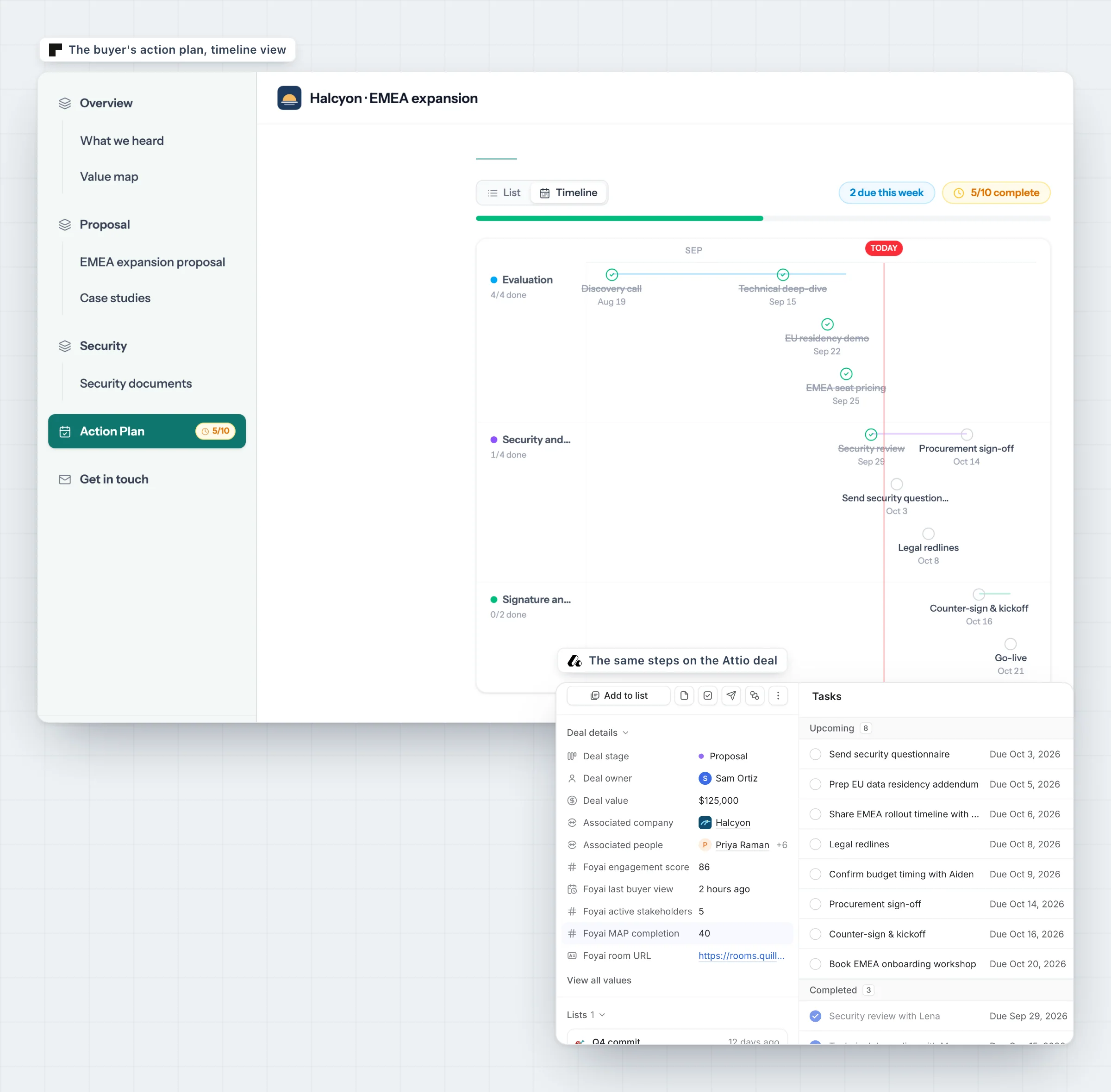
- Owners, dates and a timeline view. Owners link to the deal's stakeholders, steps can carry descriptions and attachments, and email digests flag tasks coming due.
- Buyers tick off their own steps. When the room asks buyers to sign in with their email, they can complete steps and add new ones.
- Synced with Attio. Steps you add are created as Attio tasks with the room link, and steps suggested from calls sync once you keep them. Complete it in Attio and the room updates; dates and completion stay in sync. Each deal carries a MAP completion percentage you can sort, filter and report on.
Read more in the rooms docs, or see where the plan fits at each stage of a deal in use cases.