A business case your champion can forward.
A business case in B2B sales is a one-page document that sets out, in the buyer's own terms, what their problem costs today, what changes if they buy, and why the decision should happen now. The seller drafts it from discovery notes, the champion sharpens it, and it goes to the economic buyer, who usually wasn't on your calls. This template has seven sections, a cost-of-inaction worksheet and a worked example in each.
Updated
Business case: [Project name] at [Buyer company]
For: [Economic buyer, title] · Prepared by: [Champion] with [Seller] · Date: [Date]
1. The situation today
[Two or three sentences in the buyer's words: how the work gets done today, who it affects, and what made them start looking.]
Example: Say a 12-person sales team sends proposals as email attachments. Reps re-send the same deck several times per deal, and managers can't tell which buyers have read anything until a deal is lost.
2. What it costs
[Put a number on the problem using figures the buyer gave you. Label estimates and confirm them with the buyer. Delete rows that don't apply.]
| Cost of doing nothing | Your numbers | Per year |
|---|---|---|
| Time spent on the problem | [Hours a week] × [people] × [hourly cost] × [working weeks] | [$] |
| Revenue delayed or lost | [Deals or customers affected] × [average value] × [share at risk] | [$] |
| Tools and workarounds it requires | [Current tools, contractors, manual fixes] | [$] |
| Errors and rework | [Incidents a year] × [cost per incident] | [$] |
| Total cost of doing nothing | Sum of the rows above | [$ per year] |
Example: 12 reps × 3 hours a week × $60 an hour × 48 weeks = $103,680 a year spent rebuilding and re-sending follow-up.
3. What changes
[Two or three outcomes the buyer said they want, each tied to a cost above. Describe outcomes, not features.]
Example: Reps send one link per deal instead of attachments, so re-send time drops by half. Managers see which deals have an engaged buyer before the forecast call, not after the deal is lost.
4. Why now
[The date or event that makes this urgent: a hiring plan, a launch, a renewal, a board target. Say what slips if the decision moves a quarter.]
Example: Six new reps start in March. If the new process isn't in place by then, they learn the old one, and the cost in section 2 grows by half.
5. Proof
[One or two customers like them, the result they got, and a link to each case study. Pick the closest match by size, industry or use case.]
Example: [Customer name], a software company of a similar size, cut proposal turnaround from five days to two within a quarter. Case study: [link]
6. The ask and next steps
[What you're asking the economic buyer to approve (scope, price, term, start date), then the next three steps with owners and dates. Link the mutual action plan if you have one.]
Example: Approve a 12-seat annual plan starting March 1. Next: security review by Feb 7 (IT), contract approved by Feb 14 (Finance), kickoff on Feb 21 (both teams). Full plan: [link]
7. Risks and how we'll handle them
[The two or three concerns raised on calls, each with what you'll do about it and who owns it.]
Example: Risk: the team is midway through a CRM migration. Plan: start with one team in April, roll out to the rest once the migration closes in May. Owner: sales ops.
From discovery notes to the budget owner's desk.
Write the business case for a budget owner who wasn't on your calls and may never have heard of you. It has to make the case in meetings you won't be in.
- The buyer's goal, in their words
- Any numbers they mentioned
- The date they're working toward
- Who else decides
- Seven short sections
- Numbers the buyer gave you
- One clear ask with dates
- Read without you in the room
- Answers "why this, why now"
- Ends with a decision to make
foyai drafts the first version from each deal's calls.
Connect Attio and your call recorder, and each deal's sales room starts with the buyer's situation and goals already written. You edit and publish. Nothing reaches the buyer before you've reviewed it.
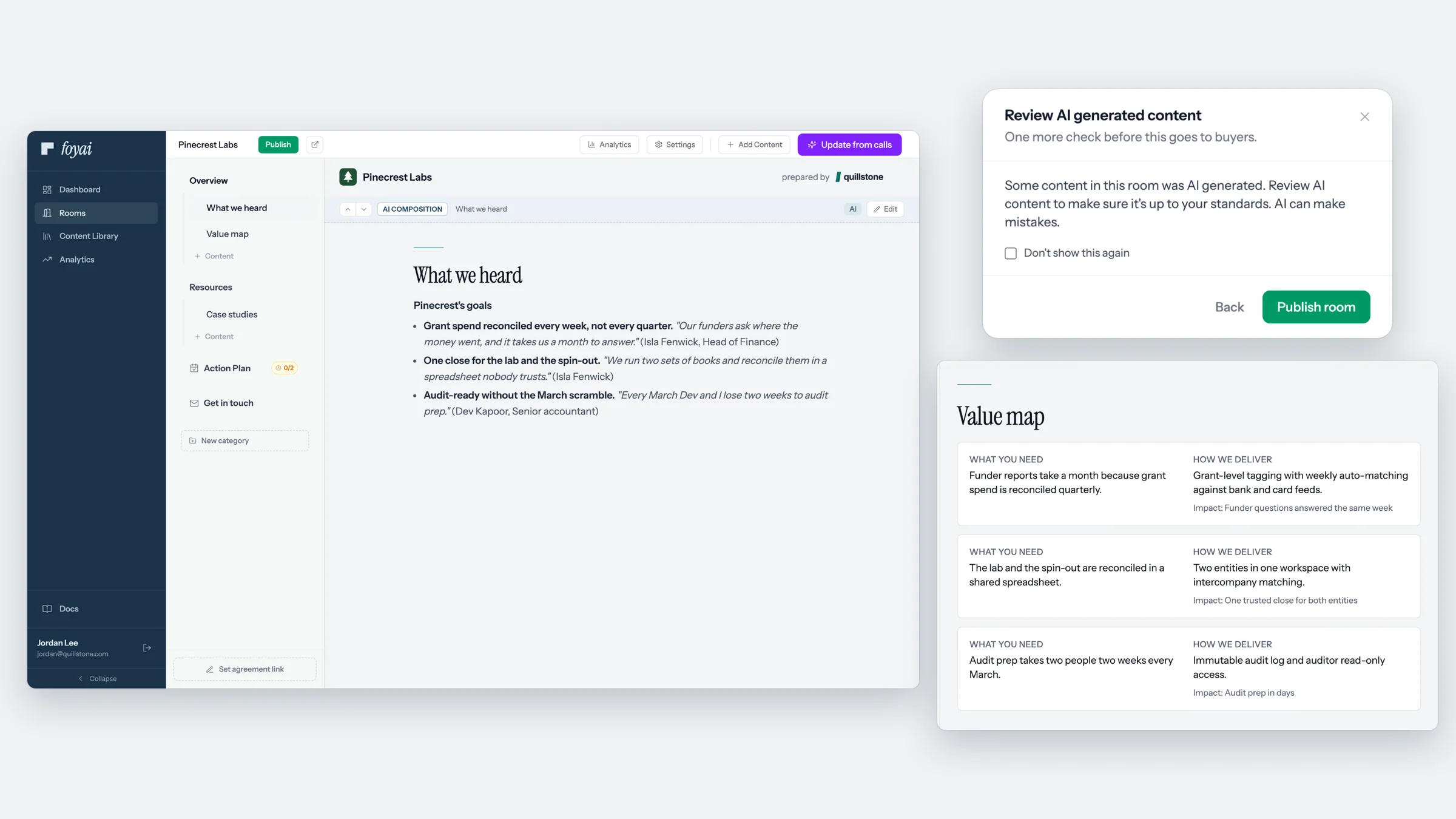
The AI is instructed to write only from what was said on the calls and not to add numbers, names or commitments. Check them against the call before you publish. When a new call is recorded, foyai suggests updates to the room for you to accept or dismiss. How AI drafts work.